California has more solar installations than any other state. And as technology continues to improve, more homeowners are asking about solar roof shingles as an alternative to traditional panels.
At The Roof Masters, we work on both the roofing and solar side of these projects, which gives us a ground-level view of when solar shingles make sense and when they do not.
This is what we tell homeowners who are thinking about them.
What Are Solar Roof Shingles?
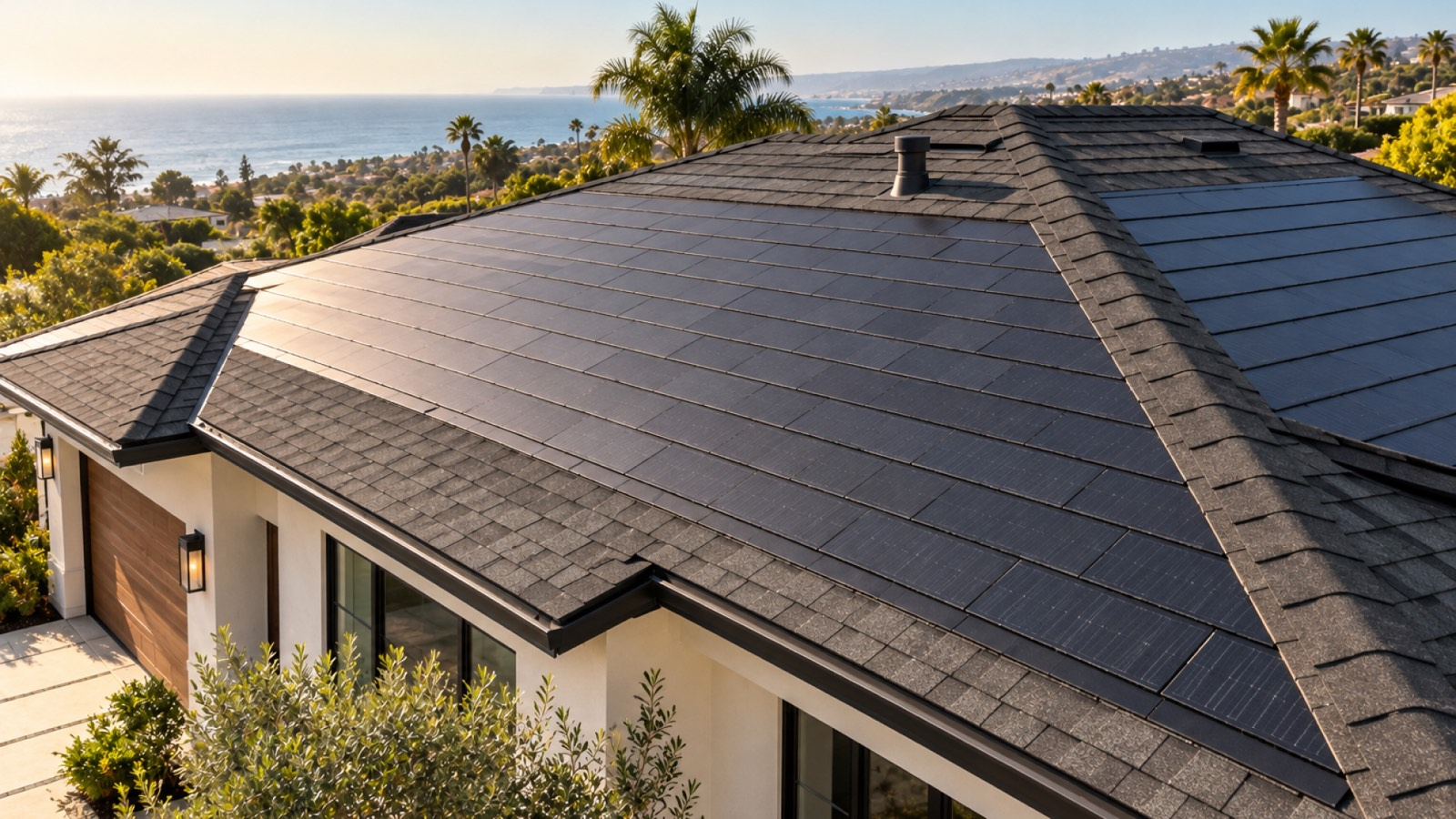
Solar roof shingles, sometimes called solar tiles or integrated solar roofing, are roofing materials that generate electricity from sunlight. Unlike traditional panels that mount on top of an existing roof, solar shingles replace the roofing material itself.
The result is a roof that produces energy without the raised panel look a lot of homeowners want to avoid.
The product we work with most in this category is the GAF Timberline Solar shingle.
It functions as a roofing shingle and a solar system in one, installs alongside standard asphalt shingles, and qualifies for the federal solar tax credit.
How Do They Work?
The same way traditional solar panels do. Photovoltaic cells in the shingles convert sunlight into electricity, which runs through an inverter and feeds into your home's electrical system, reducing what you pull from the grid.
The difference is how they sit on the roof. Standard panels mount on a racking system above existing shingles. Solar shingles are the roofing layer itself, so the installation is a roofing project and a solar project happening at the same time.
That integration is both an advantage and a complication. Done right, you get a clean, low-profile system with no visible hardware. Done wrong, it can compromise the roof's waterproofing and create problems that cost far more to fix than the solar ever saved.
This is why we inspect and prepare the roof before any solar work starts. We have seen what happens when solar gets installed on a roof that was not ready for it. Leaks, structural stress, and repair bills that dwarf the original installation cost. It is not a good situation.
Solar Shingles vs. Solar Panels: What Is the Actual Difference?
This is the question we get most often. Here is a plain comparison.
Solar Panels: Panels mount above the existing roof on a racking system. They can be added to most structurally sound roofs without tearing anything off. They generate more electricity per square foot than most shingle products, cost less upfront, and have a longer track record in the field. There is a reason they are still the most common solar solution in California.
Solar Shingles: Shingles replace the roofing material entirely, which means you need a full reroofing project to install them correctly. They cost more upfront, but they eliminate visible hardware and serve as both a roof and a power source. For the right home, that combination makes a lot of sense.
The better choice depends on your roof's condition, your budget, your energy goals, and whether you are already planning a replacement.
Consult with an expert at The Roof Masters.
Is California a Good Fit for Solar Shingles?
For a lot of homes, yes! A few reasons.
Sun exposure is consistent and strong across most of the state.
More sun means more output, which improves the return on any solar investment. California also has some of the highest electricity rates in the country, so every kilowatt you generate yourself is a kilowatt you are not paying the utility for.
The federal solar tax credit currently allows homeowners to deduct 30% of the total installation cost, and California offers additional incentives based on the utility and location.
That said, not every home in California is a good candidate for solar shingles specifically.
The product, the roof, and the situation all have to line up.
When Solar Shingles Make the Most Sense
You are already planning a full roof replacement. If the roof needs to come off anyway, upgrading to a solar shingle system during that project makes real financial sense. Labor and tear-off are already in the budget. The incremental cost of going solar at the same time is much lower than doing it as a separate project later.
You want a clean roofline. Solar shingles remove the visible racking hardware that traditional panels require. For HOA properties, premium homes, or homeowners who just do not want their house to look like a science project, this matters.
Your roof gets good sun. South or west-facing roofs with minimal shading from trees or neighboring structures will generate the most power. A heavily shaded roof may not produce enough to justify the cost.
You are building a new home. New construction is the natural fit. The roofing and solar systems get designed together from the start, which is cleaner and more cost-effective than retrofitting either one later.
When Traditional Panels Are Probably the Better Call
We say this to homeowners regularly and we mean it: solar shingles are not always the right answer.
If your roof is in solid condition and does not need replacement, going the solar shingle route means tearing off a functional roof to install a new one. That adds cost and waste and does not make much financial sense. In that case, mounting traditional panels on what you already have is almost always smarter.
If maximum energy output is the goal, panels still win on production per square foot. For homeowners trying to offset a large electricity bill or get close to net-zero, panels typically deliver more power at a lower cost.
If budget is the main factor, panels have a lower entry price in most cases. The payback period on solar shingles is longer. That does not make them a bad investment, but it is something to go in knowing.
A Note on GAF Timberline Solar Shingles
This is the integrated solar product we install and recommend at The Roof Masters.
Timberline Solar shingles are nailable, meaning they go down like standard shingles rather than requiring a separate racking system. The profile matches architectural shingles, so the finished roof looks consistent. They qualify for the 30% federal tax credit and carry GAF's roofing warranty.
As a GAF Master Elite contractor, we are certified to install these systems correctly. That certification matters because the roof's waterproofing depends entirely on the installation being done right. A shingle that is not seated or sealed properly is not just a solar problem. It is a roof problem.
We look at the roof before any solar work starts. If it is not in the right condition, we say so. If solar shingles are not the right fit for the home, we say that too.
What Does This Actually Cost in California?
It varies. A full solar shingle installation costs more upfront than mounting traditional panels on an existing roof. That is just the reality.
The math changes when a roof replacement is already in the plan. At that point, the cost difference between a standard re-roof plus panel installation and a solar shingle re-roof narrows significantly.
The 30% federal tax credit applies to the full installation cost, which takes a meaningful amount off the top.
For an accurate number on your specific home, you need a roof assessment and a solar consultation. We provide both at no cost, and there is no pressure to commit to anything.
Key Takeaways
- Solar roof shingles replace the roofing material and generate electricity at the same time
- California's sun exposure, electricity rates, and available incentives make it a strong market for solar of any kind
- Solar shingles work best when paired with a full roof replacement or new construction project
- Traditional panels are usually more practical when the existing roof is in good condition
- GAF Timberline Solar shingles are the integrated solar product we install and recommend
- Proper installation by a licensed roofing contractor is critical to both roof integrity and long-term solar performance
- The 30% federal tax credit applies to qualifying solar shingle installations
Want to Know If Solar Shingles Make Sense for Your Home?
We regularly assess roofs for solar readiness.
We look at condition, orientation, shading, and age, and give you a straight answer on whether solar shingles, traditional panels, or something else makes the most sense for your situation and budget.
No pressure. No upsell. Just a clear read from a team that works on both sides of this.
Book your free solar roof consultation with The Roof Masters.
FAQs: Solar Roof Shingles in California
What are solar roof shingles? Solar roof shingles are roofing materials with built-in photovoltaic cells that generate electricity from sunlight. They replace the traditional roofing layer instead of mounting on top of it, which produces a cleaner look than standard panels.
Are solar shingles worth it in California? For the right home, yes. Strong sun, high electricity rates, and the 30% federal tax credit make solar a solid long-term investment in California. Solar shingles specifically make the most sense when a roof replacement is already planned or when aesthetics are a real priority.
How do solar shingles differ from solar panels? Panels mount on top of an existing roof using a racking system. Shingles replace the roofing material itself. Panels typically cost less and produce more energy per square foot. Shingles look cleaner and work best as part of a full roof replacement project.
What is the GAF Timberline Solar shingle? GAF Timberline Solar is an integrated solar shingle that installs like a standard architectural shingle. It generates electricity, qualifies for the 30% federal tax credit, and carries GAF's roofing warranty. The Roof Masters installs it as a certified GAF Master Elite contractor.
Do solar shingles qualify for the federal tax credit? Yes. Qualifying solar shingle installations including GAF Timberline Solar are eligible for the 30% federal solar Investment Tax Credit, which applies to the full installation cost.
How long do solar shingles last in California? Solar shingles are built to last as long as the roof itself. Most solar products are rated for 25 to 30 years of performance. Specific warranty terms vary by product and should be confirmed at time of installation.
Can I install solar shingles on my existing roof? Not without replacing the roof first. Solar shingles require a full reroofing project to install correctly. If your existing roof is in good shape, traditional solar panels mounted on the existing surface are usually the more practical option.
How do I know if my roof is a good candidate for solar shingles? A professional assessment is the right starting point. Key factors include roof age and condition, sun orientation, shading from trees or nearby structures, and whether a replacement is already in the plan. The Roof Masters provides free assessments for California homeowners.